Friday, August 29, 2008

Chimpanzees for Sale


I’m a bit disturbed upon finding out that a lot of my traffic from Google is coming from people searching for “chimpanzees for sale”

I don’t know how to say this strongly enough, but no. Chimpanzees are NOT pets. Can you imagine asking your Aunt Joan to keep her son Bobby as a pet? It’s nearly as outrageous a question.

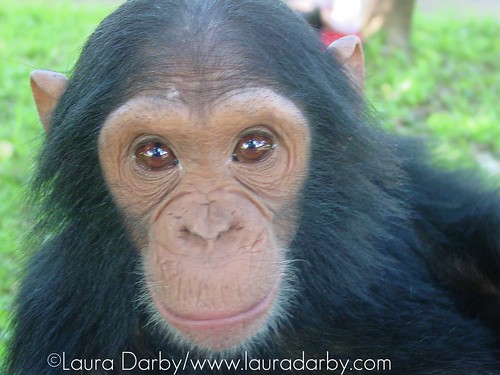
Chimpanzees need their own mothers -- they’re raised by them their whole lives and aren’t even weaned until 4 or 5. It’s people who are looking for chimpanzees as pets that fuel the pet trade.

It’s an infuriating question, because you want to be mean and yell at people for being ignorant, but you also want to reason with them and explain WHY it’s a bad idea, and people tend not to listen if you’re screaming.

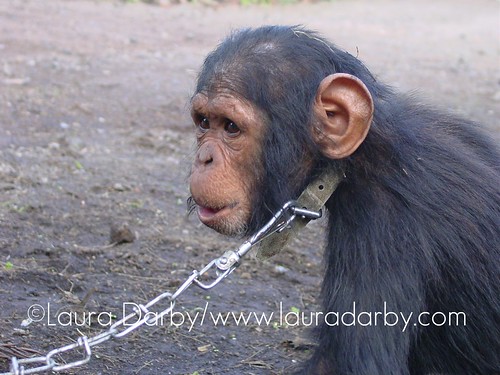
One of the reasons that I and countless others must dedicate our lives to protecting chimpanzees and gorillas and caring for them in sanctuaries is because they were “spared” for their value as pets. Mistreated, malnourished, abused at the hands of their captors, it’s a miserable life. The bulk of chimpanzees do not even make it into sanctuaries or loving homes. They’re left at roadsides, for sale, sitting melancholy with chains around their necks and amoebas in their bellies. Most die.

For every chimpanzee orphan, you must assume that a family of chimpanzees had to die for the infant to be taken. Would you let a stranger take your baby without a fight?

Regarding the safety of owners of chimpanzees, they grow incredibly fast and a four year old will probably be as strong as four of you. They’re territorial, unpredictable, and can’t communicate with you in any way you’ll understand other than biting and screaming. And trust me, their teeth are SHARP.

Male chimpanzees don’t like other males invading their territory, and they want to be as efficient as possible in their attack, so they go for the dangling, external bits. Like your fingers.

And your balls.

So if you want to have your fingers bitten off and your balls ripped off, sure, go ahead and have a chimp as a pet.

Some other opinions:

From Lola Ya Bonobo (a bonobo sanctuary in DRC)

From the Humane Society

Thursday, August 28, 2008

Etaito RIP


One of the most difficult parts of mothering an orphaned chimpanzee is really that you become just that -- a mother.

While I was at the Primatology Congress in August, I got to sit down and have a nice lunch with my mentor and one of the busiest women in primatology, Debby Cox. It was she who first sent me to Goma, scared, alone, to take care of three little chimps who were also scared and alone.

Although I bonded with all of my chimpanzees while I was in Goma, the first chimpanzee to ever approach me was Etaito. He was the only male chimpanzee we had at the time, named for the district he was confiscated in.

You should always realize when you meet a chimpanzee who is aggressive and scared and protecting him/herself that it has already had a hard life. Infant chimpanzees are typically sheltered by their mothers -- protected and nursed and not weaned until the age of 4. They live in cohesive communities, and never have to worry about the outside world outside of their families.

But Etaito -- only a year when I first met him -- was viciously scared. He would approach any strangers with a fortitude that merely masked the fear he felt when they “invaded” his home.

In the morning, I would sit out on the front porch as the chimpanzees were eating, eating myself. I liked apples -- and they were easy to get at the local market. Etaito liked apples too, and would sit on my lap, often just taking pieces of apple from my hands, or from my mouth! Some days he’d come to the window of my room in the afternoon, and watched as I cleaned up or did my little exercises.

Etaito was the first. Not the only, but definitely the first. The first real chimpanzee that I felt trusted me as much as I trusted him.

I found out during my lunch with Debby at IPS that Etaito had died. Of meningitis, a curable disease in a chimpanzee. He had died right after I left the sanctuary, but no one had told me.

I’ll admit, I cried into my sandwich. It was unexpected, and the grief still lingers with me, welling in my eyes as I look through my photos to pick ones to go in this entry.

This entry is for Etaito. And for all the infant chimpanzees that are orphaned, and don’t make it.

There will be many more chimpanzees I take care of in my career, but Etaito will always be the first.


Etaito during morning feeding


Exhausted after an afternoon of play!


Chimpanzee Pedicures are the best kind

IPS: A Recap

It’s been too long since I last updated, but I’ve been really busy not only traveling but preparing for the trip.

I spent the early part of August attending The International Primatological Society Congress. I helped organize the last congress, 2 years ago in Uganda, and I was really keen to go and reunite with people that I hadn’t seen since.

The funny part was, the conference ended up being more successful thanks to people I hadn’t met before than people I had!

I’ve been feeling much more confident since the conference, since there was certainly some doubt in mind regarding the complete novelty of my research -- there were no published papers, or abstracts, or reports on my subject to base my protocols on. What would happen if I used the wrong sample preservation techniques? All puns aside, but that would be really shitty!

Had I only known the real boon of the conference would be meeting people I’d never met before!

Most importantly, I met Tom Gillespie, who is pretty much the foremost primate parasitologist. I got a chance to see some of the work he’d done but not yet published at the periphery of the Goualuogo Triangle -- a chimpanzee study site in the Republic of Congo that is right next to several logging concessions.

How relieving to see that I wasn’t completely plowing ahead with no guidance, and Tom offered to set me up with a great set of collection protocols for my fecal samples that he and his colleague developed while collecting in RoC.

Wooo! I also spoke with a Dr. Leslie Knapp, who works on genetic testing of the Bili chimpanzees (the same chimpanzees I will be testing). She is hoping to get access to my samples in order to do genetic analysis on them as well, since her current sample size is from a small collection of hair and bones.

I think too one of the most exciting parts too was the legitimacy I felt -- my own research, finally, after years of planning, with real potential and the excitement of not only myself but my PEERS behind it!

I wish that I had been able to stay for the whole conference, but I’d promised Adam to be back in the States for his second degree black belt exam. And, since I was traveling internationally, I had to leave myself plenty of time to get back.

He did eventually decide not to test, but I believe that the time I spent at IPS was well-served. And of course, hanging with old friends from the last IPS, like Debby, Chris Golden, Lillian, and Alex (who I worked with all the way back in 2002 when I was in Kenya with Blue Monkeys).

I’m still working towards finishing my IRB proposal, and getting my supplies ready, and I still need to go over the collection protocol.

There is so much to do, yet!

Wednesday, July 16, 2008

The Chimpanzees

To prep me (and excite me!), Cleve sent me photos of the chimpanzees we'll be caring for while we're in Aketi.


This is Kathe, the older female.

And this is Bolungwa, aka "Baby Bo"! 

Cleve and the team have been offered 15 chimpanzees for sale since September 2007, not including the chimpanzees offered for sale as bushmeat.

I'm hoping to be able to confiscate more orphans after setting up a better support system for them.

There is a lot of work to be done...

Excitement of Research

One of the things I’ve been especially anxious about has been how in the world I will be able to tackle some of the components of my research.

I mean, saying “I’ll be collecting fecal samples from these people” is one thing to theorize... but practically?

Many people are superstitious. I have hair the color of fire. I am an unmarried woman. Also, if you weigh me down in the Salem Lake I won’t drown.

(WITCH!!!!! WIIIIIIIIITTTCCHHHH!!!)

So you can imagine me coming up to some people and asking them for their poop? Agh! So I’ve been at odds, contemplating how exactly I’m going to accomplish doing what I need to get for my analysis?

Anyway, I was discussing over email (and one hilarious Skype phonecall) with Cleve about the samples I’d need to obtain and how. And he filled me with such confidence!

“AMAZINGLY, AT MBANGE WE FOUND A CHIMP NEST DIRECTLY OVER A SEVERAL YEAR OLD MINE, AND SEVERAL MORE NESTS WITHIN 300 OF A LARGE CURRENTLY WORKED MINE (COMPLETELE WITH 2 GRUBBY BEE-COVERED MINERS WHO LOOKED LIKE THEY MIGHT HAVE SOME VERY INTERESTING STUFF IN THEIR FAECES!! YOU SHOULD DEFINITELY GO TO MBANGE.”


So that’s excellent! And, somewhat controversially, “THEY ARE PRETTY EASILY BOUGHT... A SMALL PRIME AND I IMAGINE YOUR CUP WILL BE FLOWING OVER.”

It does reassure me that, at the very least, I won’t have trouble *getting* the samples. Now I just need to get IRB approval so that no one thinks I am abusing people when I take their poop.

Having Cleve there is incredibly comforting. His knowledge, his existing relationships with the local people... his presence there will be a boon to my possibilities.


Cleve and the gang.

Preparation 2.0

Adam and I went to Campmor this past Sunday to get items for our first couple of weeks in Congo -- being in a crumbling Belgian mansion is one thing, but being in the jungle in a tent is something completely different. And requires different preparatory things!

Many of which we a) didn’t have and b) weren’t planning to get.

(If you’re needing some backstory, check this entry)

So anyway, we went to Campmor to get Adam a hiking bag, maybe some sleeping bags (either a double or two bags that were twinnable/combinable), and some general camping essentials. We’re not sure entirely what we’ll need, but Cleve had told me that, when getting a tent, I should just make sure it’ll protect me against termites and ants. If there’s one thing I know from experience that you DON’T want in your tent, it’s safari ants.


What I didn’t count on was the fact that Campmor... and all of Paramus township.... is CLOSED on Sundays. We’d driven all the way out to New Jersey, only to have to drive all the way back. The REI that used to be at Columbus Circle was closed, so we had no choice but to go to Paragon Sports, a “huge” (by NYC standards) sports store at Union Square.

I wanted to get Adam a bag like mine -- I’ve had my bag since about 1996 and it’s only just now starting to show signs of wear. I’ve dragged it ALL over the world until finally, as I came back from Congo the last time, it finally lost a piece and broke. But I called Kelty and told them about the piece my bag was missing, and they’re sending it to me for only $5!!


This is me in Kisoro, Uganda, at the FAMOUS Traveller’s Rest Inn -- where George Schaller and Dian Fossey stayed!
Add Me and My Trusty Kelty Bag to the list of famous residents. Hehe.

Anyway, there were no real tents on display to get inside. The salesguy didn’t even know about the Nemo Morpho tent we were looking at, and when I tried to voice my concerns about the footprint and the carnivorous ants, and our salesguy, sort of a sad stereotype of himself with his patchouli’ed whiteboy dreadlocks, had absolutely no idea what I was talking about and offered no suggestions for conversational compromise.

We did get into the one tent that they had, and it did fill me with excitement. Of course, we also have to figure out how to get Adam sleeping in a position in-tent that will be comfortable for him (he sleeps sitting upright to help his snoring and his back)

We wanted to get a Kelty bag for him, but, as our own salesguy said, “Oh, they’re fantastic bags, but this store is way too trendy to sell them.” Instead, we got him a good North Face bag and he got used to carrying it around, full of sample things from the store.

There is still so much to get, but it feels nice to be moving forward, however slowly. And I’ll know that, if I wear myself out with my to-do listing, I can always crawl inside of Adam’s new bag and he can carry me around.

Questions From Me - Answered by Cleve

If you have questions, feel free to leave them in the comments here!

How is the weather?


Either hot and wet or hot and dry. The rainy season lasts from about May - November and you will be arriving at its height, so bring good rain gear and a rain-proof tent. The dry season is very dry, bring good water bottles, and polar bar water purifier tablets if you can (I boil my water). It can get chilly at nights at this time. The dry season is usually easier on my health, and the roads are a lot easier to travel!

How are the people?

It is a mix; they can be so generous and sweet, and also so greedy (mainly in the towns). There is a lot of resentment and jealousy towards whites, more than i have seen in other countries. A lot of aggressive begging (but not as much in smaller villages). The Congolese also love loud and noisy debates, and that is just something to get used to. But they also love having foreigners here, and we have some friends who would give you the shirts off their backs.

How dangerous is it? (This might sound lame, but I would like to know)

Well, these things can change with outbreaks of war, etc;, but I have rarely if ever felt physically threatened here (except at Bili a few times, where we had elephant-poaching soldiers harrassing us in the town); it is not dangerous like in the Virungas, for example. The worst thing I have to deal with is harassment by corrupt officials (it gets very annoying), but nowadays a phone call from Michel usually puts an end to that quickly. We have a lot of friends looking out for us...

But it is Congo, and things can always change. During the civil war, I have heard that the soldiers were a nightmare. So it always good to keep up on current events in Kinshasa. But Hans, sunny and I will help you do that.


How is the food? The water?

I like the food, but for a vegetarian the diet can get a little boring after a while: manioc roots and leaves, beans and rice, gourds, fumbwa(white forest leaf) and mushrooms. But I just found some potatoes in Buta, which has livened up my diet considerably. The water is fine when you boil it.


How is the mansion?

Comfy, for Congo. And very secure, although people steal things from the yard (like my rain gauge).


What do people do for a living?

In Aketi and Bili, mostly work the fields: manioc, corn, etc. And hunt and fish. But emanating from Buta is a rapidly-expanding diamond and gold industry.


What languages are spoken besides Swahili and French?

Lingala (the lengua franca), and in Aketi and Buta, Kibenza and Kiboa. There are some Azande (as at Bili) who speak Kizande towards the North. Kiswahili is actually not so common here

How often can I get on the Internet?

Through the began (which maybe Hans will let me leave with you) --- if for some reason that doesn't work, you can take a trip to Buta (a days motorbike ride) and use Zefas cybercafe (where i am now).

How is the town?

It is basically the crumbling ruins of an old Belgian train station town, with people sort of inhabiting the decaying mansions without actually maintaining them. The people are pretty friendly, especially since Michel and Polycarpe come from there. It is a hell of a lot more calm than Bili!

How is the bathing situation?

There is a bath tub with a big barrel of cold water beside it and a scoop.


What things should we bring with us beside the obvious?

I will work on a list. Bring antibiotic pills (though you can buy them here), malaria medicine, and maybe dec against filaria (ask your doctor). And lots of good books!


What is the shopping situation? (Like street market) What can we buy?

No problem with foods, and medicines aren't a problem for me. But forget anything like quality AA batteries or really quality anything. But flashlights, lighters, etc are available

What are some of the important customs?

Let me think on that one. It is an almost socialistic society, which can be good, ie. People look out for one another and for you, but also bad: jealousy of anyone who 'rises above' and, say, gets a higher salary. The latter is a very bad problem and you have to be very careful not to 'play favorites'.


How is the phone situation?

You can use your cell phone in Aketi and Buta, but not anywhere else. This may change soon (ie. More towers will be built).

How often do you talk to the locals?

Well? Considering i live with 6 of them, most of the time. But yes, i do go out and talk with folks about our work, and spend a lot of time with people near the sanctuary.


What is the best way to travel?

Motorbike, or bicycle for shorter distances.