Tuesday, September 9, 2008

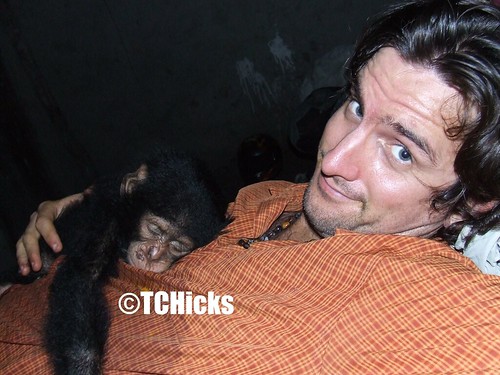
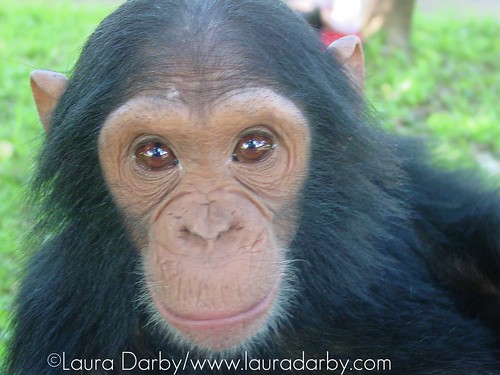
Cleve and Mangé

As I mentioned previously, the Aketi Two has recently become the AKETI FOUR!

One of the dangers of starting a sanctuary or taking in chimpanzees is that, if you put an inadvertent placard outside your door, you will be swimming in orphaned chimpanzees in no time.

Cleve has already been offered 23 chimpanzees for sale in the last six months alone.

And, for those not in the know, Never, Ever, Ever pay for an orphaned chimpanzee. It sets a very, very dangerous precedent.

Baby chimpanzees should never been perceived to have a value, or it will encourage people further to slaughter their families and pull them from their jungle homes.

Mangé just arrived at Aketi -- as you can see, he is incredibly small. Cleve was not sure he would make it, but thus far, he is doing fine.

Wow! A Productive Day!


It’s the last day in Maryland for Adam and I before we go to New York City to say goodbye to our family and friends. We come back through PA and NJ to say goodbye to Adam’s family on our way back down on Saturday, and then have Sunday only before I go back to Johns Hopkins for 12 more days.

And our plane tickets are for October 4th!

The takeaway message here: there isn’t much time left before we have to go.

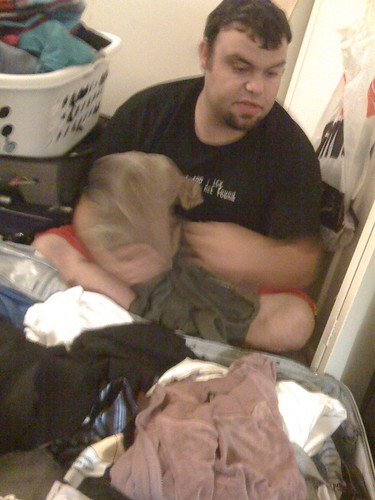
Thankfully, being in the JHU study and Adam leaving his job last month has actually left us with the time to go through the multitude of crap we’ve accumulated separately and together, throw 90% of it away, but 5% of it into storage bins to deposit in friends’ basements, and 5% of it into suitcases and ready to go to Congo.

It’s going to take a little bit of extra time, but we decided instead of throwing a bunch of stuff away that we’d donate it to Furniture and Goodwill banks -- Adam has hordes of old VHS tapes and 3 winter coats he’ll never wear again -- not to mention books that he’s outgrown, and we thought it’d be the better thing to do.


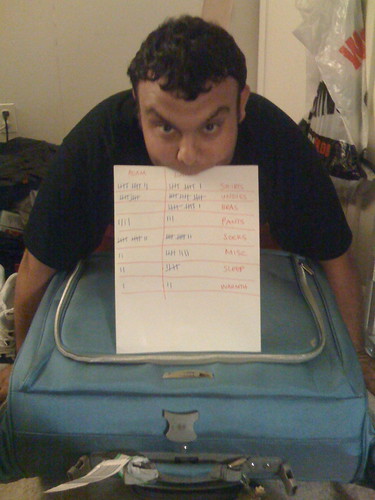
We officially know every piece of clothing that is coming to Congo with us. We made a list:

Socks
Shirts
Undies
Bras/tanktops
Pants
Warmth
Miscellaneous
Sleep


and tallied everything that went into the suitcase. According to airline regulations, we’re each allowed 2 32kg bags (~70 lbs/each bag) to check under the plane, and 2 smaller-sized carry-on bags.

ALL of our clothing is in ONE bag! For Two People! I’m really impressed with us.

More importantly, this leaves us with 3 other bags for our sundries. I’m also leaving extensive amounts of empty space in ONE of our bags, because it will allow me to carry my (fecal) samples back to the US and not worry about running out of space.

It’s a lesson I’ve only ever learned the hard way: If you overpack your bags GOING to a destination, where do you put all the crap you accrue while you’re there in the luggage for the ride home? :)

Sunday, September 7, 2008

The Expense of it All - Preparation Continues

Suddenly, our schedule is counting down days and weeks instead of months. How time flies!

And now that Adam and I are both not working, and just relying on study money and savings and “miscellaneous“ (parental donation fund), collecting our various Congo necessities.

It’s quite different for me this time, which I think I’ve mentioned before, because I’ve lived in various countries in Africa before, but never anywhere quite so remote.

In Entebbe, we could go up the road to ”The Indiscriminate Pharmacy“ as we called it, and get any sort of drugs we needed. Aketi is a village, not a town or a city. Buta, the closest town, is far enough away that I’d rather make my visits there less frequent.

There is also no guarantee that many of our standard ”necessities“ are available in Buta.

Ergo, we must bring everything with us. Pharmaceuticals? Chargers? Extra batteries/bulbs/hodgepodge? Yup, Yup, and Argh. Yup.


I’ve not bought stock in Ziploc, but I have separated all of our various needs into blanket health categories, like:

COLD AND FLU SKIN/SUN CARE ALLERGIES FOOT PAIN

in attempts to provide us with our own little Western-quality pharmacy-in-a-suitcase.

But it all adds up.


Dear Cthulhu/<Insert Deity here>, why must you make me shell out cash now for drugs I might need when I have diarrhea 7 months from now?

Sometimes, life is cruel.


I’m also going to have to wean myself from the internet. Because while we’re in Aketi, we will be using a BGAN primarily for internet. The good news is that our NGO is
providing us with the actual hardware -- the potentially bad news is that we might be paying for some, or ALL of our monthly BGAN service charges.

The thing I am learning all-too-quickly is that everything having to do with the BGAN costs a helluva lot. It is, literally, a hefty price to pay for being connected with the outside world.

Do we pay $130/month and get only 20MB/month or do we spring for the ”big“ bandwidth and pay $500/month for 100MB/month?!

We’re selling Adam’s car, which will give us a bit of a bubble, but we’ve already paid $300 for a tent, and we’ve still got to sign up for International SOS ($300/person), get hiking shoes, and a sleeping bag!

I haven’t even had any children, and I’m already feeling like I’m hemorrhaging money!


(Time to call Bill Gates, maybe?)

Tuesday, September 2, 2008

New Chimpanzee


Introducing now the AKETI FOUR!

Django Mayanga was recently confiscated and brought to Aketi. He is apparently from Bili, and is currently being nursed back to health.


Friday, August 29, 2008

Chimpanzees for Sale


I’m a bit disturbed upon finding out that a lot of my traffic from Google is coming from people searching for “chimpanzees for sale”

I don’t know how to say this strongly enough, but no. Chimpanzees are NOT pets. Can you imagine asking your Aunt Joan to keep her son Bobby as a pet? It’s nearly as outrageous a question.

Chimpanzees need their own mothers -- they’re raised by them their whole lives and aren’t even weaned until 4 or 5. It’s people who are looking for chimpanzees as pets that fuel the pet trade.

It’s an infuriating question, because you want to be mean and yell at people for being ignorant, but you also want to reason with them and explain WHY it’s a bad idea, and people tend not to listen if you’re screaming.

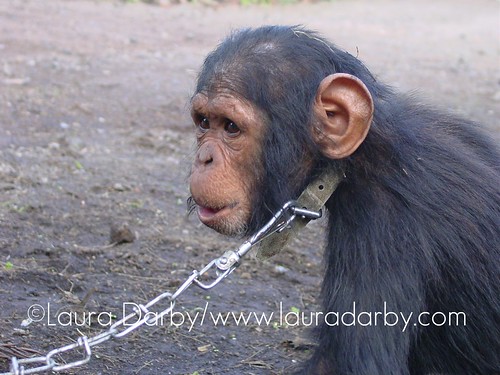
One of the reasons that I and countless others must dedicate our lives to protecting chimpanzees and gorillas and caring for them in sanctuaries is because they were “spared” for their value as pets. Mistreated, malnourished, abused at the hands of their captors, it’s a miserable life. The bulk of chimpanzees do not even make it into sanctuaries or loving homes. They’re left at roadsides, for sale, sitting melancholy with chains around their necks and amoebas in their bellies. Most die.

For every chimpanzee orphan, you must assume that a family of chimpanzees had to die for the infant to be taken. Would you let a stranger take your baby without a fight?

Regarding the safety of owners of chimpanzees, they grow incredibly fast and a four year old will probably be as strong as four of you. They’re territorial, unpredictable, and can’t communicate with you in any way you’ll understand other than biting and screaming. And trust me, their teeth are SHARP.

Male chimpanzees don’t like other males invading their territory, and they want to be as efficient as possible in their attack, so they go for the dangling, external bits. Like your fingers.

And your balls.

So if you want to have your fingers bitten off and your balls ripped off, sure, go ahead and have a chimp as a pet.

Some other opinions:

From Lola Ya Bonobo (a bonobo sanctuary in DRC)

From the Humane Society

Thursday, August 28, 2008

Etaito RIP


One of the most difficult parts of mothering an orphaned chimpanzee is really that you become just that -- a mother.

While I was at the Primatology Congress in August, I got to sit down and have a nice lunch with my mentor and one of the busiest women in primatology, Debby Cox. It was she who first sent me to Goma, scared, alone, to take care of three little chimps who were also scared and alone.

Although I bonded with all of my chimpanzees while I was in Goma, the first chimpanzee to ever approach me was Etaito. He was the only male chimpanzee we had at the time, named for the district he was confiscated in.

You should always realize when you meet a chimpanzee who is aggressive and scared and protecting him/herself that it has already had a hard life. Infant chimpanzees are typically sheltered by their mothers -- protected and nursed and not weaned until the age of 4. They live in cohesive communities, and never have to worry about the outside world outside of their families.

But Etaito -- only a year when I first met him -- was viciously scared. He would approach any strangers with a fortitude that merely masked the fear he felt when they “invaded” his home.

In the morning, I would sit out on the front porch as the chimpanzees were eating, eating myself. I liked apples -- and they were easy to get at the local market. Etaito liked apples too, and would sit on my lap, often just taking pieces of apple from my hands, or from my mouth! Some days he’d come to the window of my room in the afternoon, and watched as I cleaned up or did my little exercises.

Etaito was the first. Not the only, but definitely the first. The first real chimpanzee that I felt trusted me as much as I trusted him.

I found out during my lunch with Debby at IPS that Etaito had died. Of meningitis, a curable disease in a chimpanzee. He had died right after I left the sanctuary, but no one had told me.

I’ll admit, I cried into my sandwich. It was unexpected, and the grief still lingers with me, welling in my eyes as I look through my photos to pick ones to go in this entry.

This entry is for Etaito. And for all the infant chimpanzees that are orphaned, and don’t make it.

There will be many more chimpanzees I take care of in my career, but Etaito will always be the first.


Etaito during morning feeding


Exhausted after an afternoon of play!


Chimpanzee Pedicures are the best kind

IPS: A Recap

It’s been too long since I last updated, but I’ve been really busy not only traveling but preparing for the trip.

I spent the early part of August attending The International Primatological Society Congress. I helped organize the last congress, 2 years ago in Uganda, and I was really keen to go and reunite with people that I hadn’t seen since.

The funny part was, the conference ended up being more successful thanks to people I hadn’t met before than people I had!

I’ve been feeling much more confident since the conference, since there was certainly some doubt in mind regarding the complete novelty of my research -- there were no published papers, or abstracts, or reports on my subject to base my protocols on. What would happen if I used the wrong sample preservation techniques? All puns aside, but that would be really shitty!

Had I only known the real boon of the conference would be meeting people I’d never met before!

Most importantly, I met Tom Gillespie, who is pretty much the foremost primate parasitologist. I got a chance to see some of the work he’d done but not yet published at the periphery of the Goualuogo Triangle -- a chimpanzee study site in the Republic of Congo that is right next to several logging concessions.

How relieving to see that I wasn’t completely plowing ahead with no guidance, and Tom offered to set me up with a great set of collection protocols for my fecal samples that he and his colleague developed while collecting in RoC.

Wooo! I also spoke with a Dr. Leslie Knapp, who works on genetic testing of the Bili chimpanzees (the same chimpanzees I will be testing). She is hoping to get access to my samples in order to do genetic analysis on them as well, since her current sample size is from a small collection of hair and bones.

I think too one of the most exciting parts too was the legitimacy I felt -- my own research, finally, after years of planning, with real potential and the excitement of not only myself but my PEERS behind it!

I wish that I had been able to stay for the whole conference, but I’d promised Adam to be back in the States for his second degree black belt exam. And, since I was traveling internationally, I had to leave myself plenty of time to get back.

He did eventually decide not to test, but I believe that the time I spent at IPS was well-served. And of course, hanging with old friends from the last IPS, like Debby, Chris Golden, Lillian, and Alex (who I worked with all the way back in 2002 when I was in Kenya with Blue Monkeys).

I’m still working towards finishing my IRB proposal, and getting my supplies ready, and I still need to go over the collection protocol.

There is so much to do, yet!